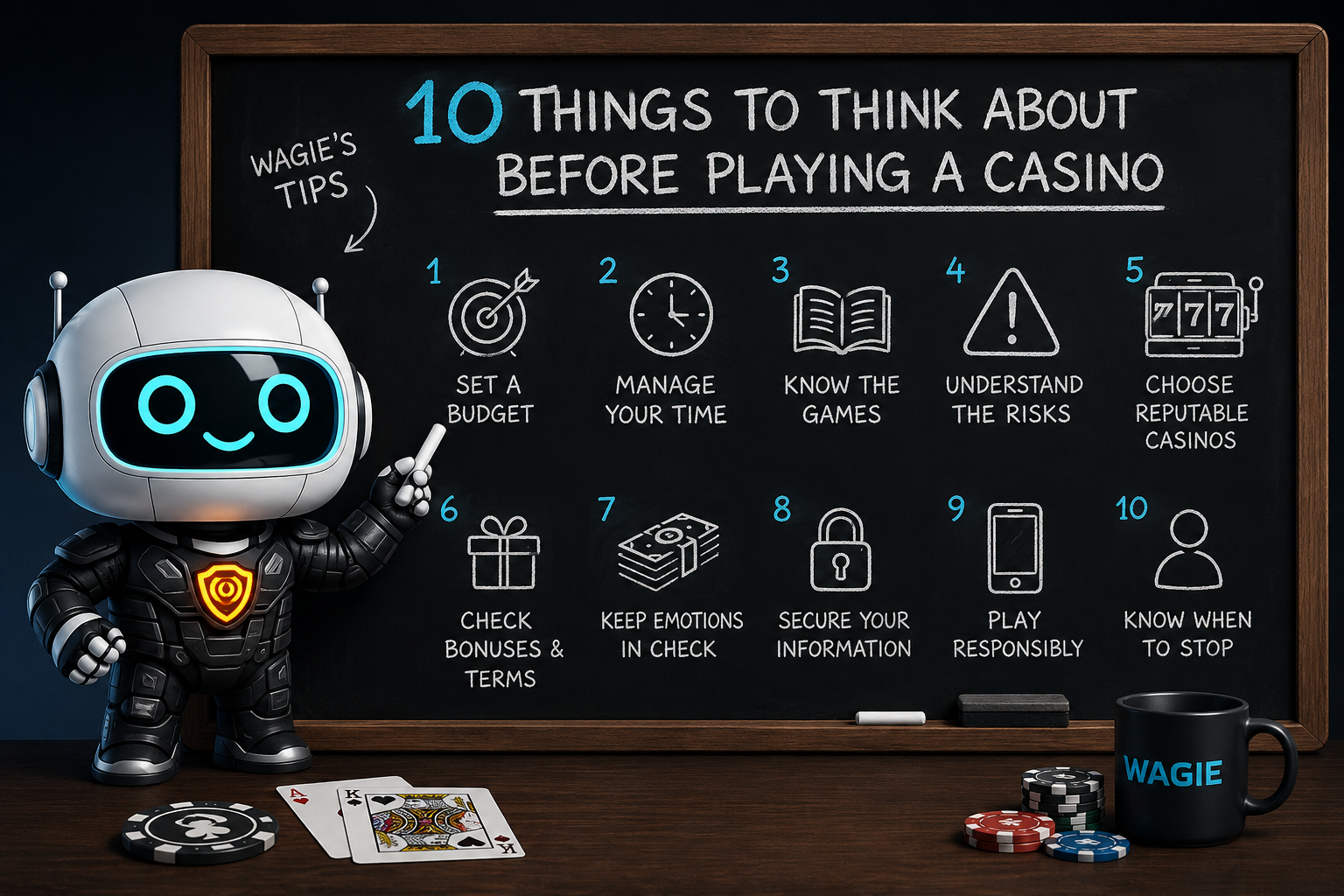
TL;DR: Ten things to settle before you play — not after you've already lost the night. Set a budget, cap your time, learn the games, respect the risks, pick a reputable casino, read the bonus terms, keep your emotions in check, lock down your security, play responsibly, and know your stop line. Want this checked against your own situation in plain language? Ask Wagie.
Most bad casino nights are not decided at the table. They are decided in the thirty seconds before the first deposit — the moment a player skips every question on this list and just clicks deposit. So Wagie put a chalkboard up. Ten things to think about before you play a single hand. None of them are complicated. All of them are the difference between entertainment and a problem.
This is not a lecture about whether you should gamble. That's your call. This is the forensic version of the talk a friend who actually understands the math would give you — the same lens we bring to every casino we rank. Read it once, keep it in your head, and most of the avoidable mistakes simply stop happening.
1. Set a budget — a real one, in advance
The single most important number in gambling is the one you decide before you start: the amount you are fully prepared to lose and never see again. Not "what I'd like to win," not "what I have in my wallet" — the amount that, if it vanished tonight, changes nothing about your rent, your groceries, or your sleep.
Treat that number like the price of a concert ticket. You paid for entertainment; the entertainment is the play itself, not the outcome. When the budget is gone, the night is over — win or lose. Write it down before you deposit. A budget you only hold in your head quietly grows by "just one more" all evening.
Wagie's rule: If you ever find yourself depositing money you originally set aside for something else, the session already failed — stop there, not three deposits later.
2. Manage your time, not just your money
Money is the budget everyone talks about. Time is the budget nobody sets — and it's the one that does the quiet damage. The longer a session runs, the worse your decisions get: judgment dulls, stakes creep up, and "I'll stop after this one" stretches into 2 a.m.
Decide your session length the same way you decide your deposit. Set an actual timer. When it goes off, cash out and walk away from a winning streak as readily as a losing one — the house edge does not get tired, and neither does it offer overtime discounts. Fatigue is the casino's best unpaid employee.
3. Know the games before you stake on them
Every casino game has a house edge — a built-in mathematical advantage for the operator. That's not a scandal; it's how the business exists. What matters is that the edge is very different from game to game, and most players have no idea which games are kinder to their bankroll.
- RTP (Return to Player) is the long-run percentage a game pays back. A 97% RTP slot keeps roughly 3% over millions of spins. Higher RTP = slower bleed.
- Volatility tells you how it pays — low-volatility games pay small and often, high-volatility games pay rarely but big. Match it to your bankroll and your patience.
- House edge on table games swings hard: blackjack with good rules and correct strategy can sit under 1%, while some side bets and specialty games quietly take 10%+.
You don't need to be a mathematician. You need to read the game's info panel before you bet real money, and ideally play it in demo mode first. Not sure what a game's RTP or volatility actually means for your stake? That's exactly the kind of thing Wagie will break down for you in plain language.
4. Understand the risks — including the ones operators don't advertise
The obvious risk is losing your stake. The less-obvious risks are the ones that turn a bad night into a bad month: a casino that delays withdrawals, moves the goalposts on a bonus, triggers a surprise KYC check the moment you try to cash out a win, or operates without any meaningful license behind it.
This is the part WagerX exists for. We don't take an operator's word for anything. We deposit real money, we play, we withdraw, and we time every step — then we publish it in our live testing notes, where every deposit, withdrawal, KYC trigger and support response is logged as it happens. If a casino is slow, evasive, or changes the rules under pressure, that's where you'll see it first, in receipts rather than promises.
Go in understanding that the edge is real, variance is brutal in the short term, and "due for a win" is a myth — each spin and each hand is independent of the last. A roulette wheel has no memory. Neither does a slot.
5. Choose a reputable casino — this is the big one
You can do everything else on this list perfectly and still lose your money to a bad operator. Picking where you play matters more than almost any in-game decision. A reputable casino pays fast, states its terms plainly, holds a real license (or is transparent about not holding one), and doesn't invent reasons to keep your withdrawal.
Here's the honest part: you can't verify all of that yourself from a slick homepage. That's the entire reason we built our best crypto casinos rankings. Every operator on that list has been put through the same forensic process — real deposits, real withdrawals, real KYC tests, real support tickets — and the results are documented, dated, and re-checked. We log all of it in our live testing notes so you can see the working, not just the verdict.
Quick filter: Before you trust any casino, check three things — does it have a verifiable license or transparent ownership, are its withdrawal times confirmed by someone other than the casino, and are its terms readable without a lawyer? If you'd rather not dig, start from the vetted list and ask Wagie which one fits your country and deposit size.
6. Check the bonuses — especially the terms under them
A "200% welcome bonus" is a marketing number. The real number is buried in the terms: the wagering requirement (how many times you must bet the bonus before you can withdraw), the max bet while a bonus is active, game weighting (slots usually count 100%, table games often 10% or 0%), time limits, and max cashout caps that quietly limit what you can ever actually take home.
A bonus with a 50x wagering requirement and a tight time limit can be worth less than no bonus at all — it just locks your own deposit behind a grind. Sometimes the smartest move is to decline the bonus and keep your money liquid. Read the fine print every single time; the headline is written to be attractive, the terms are written to protect the house.
We run welcome bonuses through a forensic decoder that turns the raw T&Cs into a clear verdict — effective value, realistic clear time, and whether it's worth taking at all. When in doubt, paste the offer to Wagie and ask whether it's actually good or just loud.
7. Keep your emotions in check
The most expensive word in gambling is "chasing." You lose a chunk, your brain screams that you can win it back, you double your stake to get even faster — and that's the exact moment the night goes from a budgeted bit of fun to a real problem. Chasing losses is how a manageable loss becomes an unmanageable one.
Wins can be just as dangerous. A big early win produces "house money" thinking — it feels free, so you bet bigger and give it all back. The discipline that protects you is boring and simple: the plan you set before you started doesn't change because of how the last ten minutes went. Never gamble to fix a bad mood, a bad day, or a bad loss. Play flat, play calm, or don't play.
8. Secure your information and your funds
Crypto gambling hands you the upside of self-custody and the full responsibility that comes with it. There's no "forgot password" button on a blockchain. Protect yourself accordingly:
- Use a dedicated gambling wallet — separate from the wallet that holds your savings. Fund it with your session budget and nothing more.
- Never share seed phrases or private keys. No legitimate casino, and no real support agent, will ever ask for them. Anyone who does is stealing from you.
- Turn on two-factor authentication on your casino account and use a strong, unique password.
- Verify the URL every time. Phishing clones of popular casinos are common — bookmark the real site and use the bookmark.
- Be careful what you connect. A read-only balance check is fine; signing a transaction you don't understand is how wallets get drained.
You can sanity-check what a wallet actually holds, in dollars, without connecting anything, using our read-only wallet checker — handy for confirming your gambling wallet is funded with exactly your session budget and no more.
9. Play responsibly — and use the tools built for it
Responsible play isn't a slogan; it's a set of concrete tools that good operators give you and bad ones bury. Deposit limits, loss limits, session reminders, cooling-off periods, and self-exclusion exist for a reason — set them before you need them, while you're calm, because the moment you need them is the moment you're least able to choose them.
Gambling should be one form of entertainment among many, never an income strategy and never a way to cope. If it stops being fun, that's the signal. And if you ever feel it slipping out of your control, free, confidential help is available — services like BeGambleAware and Gamblers Anonymous exist precisely for that, and reaching out is a strong move, not a weak one.
10. Know when to stop
Every other tip on this list leads here. Knowing when to stop is the whole game. Set your stop line in advance — a loss limit and, just as importantly, a win limit — and honor both. Walking away from a win is one of the hardest and most profitable habits a player can build, because the only way to keep a win is to actually leave with it.
Stop when your budget is gone. Stop when your timer goes off. Stop when you stop enjoying it. Stop when you catch yourself chasing. The casino will be there tomorrow; the goal is to make sure you're walking away on your terms, not the house's. A player who can stop on time has already beaten the most expensive habit in the building.
Put the checklist to work
You've got the ten questions. Here's where to take them next:
- Start from operators we've actually tested — the best crypto casinos rankings.
- See the receipts behind every verdict in our live testing notes.
- Get any of this checked against your own situation, in plain language — ask Wagie.
Wagie's Tips — published 19 June 2026 by the WagerX team. Gamble responsibly. 18+ only. If gambling stops being fun, it's time to stop — confidential help is available at BeGambleAware and Gamblers Anonymous.