
Online gambling affiliation is not dead. But a model built around buying rankings, recycling reviews and forwarding clicks is increasingly difficult to defend. The opportunity is to provide evidence that players—and the AI systems answering their questions—can check.
For more than a decade, online gambling affiliation has been an incredibly lucrative business.
The model was simple: someone searches Google for “best online casinos,” lands on an affiliate website, reads a standard review or comparison table, clicks a tracking link, and becomes a player. The affiliate earns a revenue-share or CPA commission, and the cycle repeats.
For years, this model worked exceptionally well. But something fundamental is changing.
Search engines are evolving. Regulations are becoming vastly more complex across jurisdictions. AI discovery engines are altering how users source recommendations. Established affiliates face pressure to adapt, cut overhead, and rethink their core business model.
Meanwhile, players are still asking the exact same questions:
- Where can I find a good, reliable casino?
- Which operators can I actually trust with my funds?
- How do I separate genuine recommendations from paid placement spots?
Let’s look at what’s happening—and why the future of gambling affiliation depends on answering those questions honestly.
The shift: legacy SEO vs. data-driven auditing
The primary structural flaw with commercially led gambling affiliation is that commercial incentives can dictate content visibility. When ranking positions are sold as ad inventory, the player’s true interest risks becoming secondary.
The following comparison describes two business approaches—not every traditional affiliate, and not a claim that WagerX has independently verified every operator.
| Operational pillar | Commercially led SEO model | Evidence-led approach at WagerX |
|---|---|---|
| Primary focus | Keyword visibility, click-through rates and first-time depositor conversions | Dated testing notes, audit credibility and useful risk information |
| Rankings | Positions may be sold as advertising inventory or influenced by commercial terms | Published audit scores kept separate from editorial placements and human picks |
| AI and discovery | Depends on search visibility and recommendation traffic | Structured evidence through web pages and read-only agent interfaces, with sources and limitations |
| Geography and compliance | Generic traffic acquisition can overlook jurisdictional differences | Section-level restrictions in Australia and the Netherlands, with operator-specific CTA restrictions where recorded |
| Content | Generic reviews and promotional copy can obscure important conditions | Real-money test records, terms analysis and explicit gaps in what has been checked |
The problem with the old model
One of the biggest issues with traditional gambling affiliation is commercial bias. Large affiliate groups can operate multiple websites, target thousands of high-intent keywords, and aggressively compete for search real estate. In that model, the core operation risks becoming less about helping players make informed decisions and more about controlling search results.
The result? A player searches for something specific and receives a page designed solely to convert, not to answer.
Search for new crypto casinos, for example, and a list featuring operators that have existed for five years or longer does not answer the question—unless the publisher clearly explains what “new” means. A “best casinos” table is similarly hard to interpret if commercial placements are indistinguishable from assessed recommendations.
To be fair, paid placements and commercial bias have existed in this industry for decades. This isn’t a new problem, and not every established affiliate operates this way.
But a ranking is only useful if the criteria behind it mean something.
Search engines are changing. So is the industry.
The pressure isn’t limited to content quality.
Search engines continually update how they evaluate and index publishers, making sustainable organic visibility more challenging for thin affiliate sites. Regulatory frameworks add another layer of friction, particularly for operators and publishers navigating multi-jurisdictional compliance.
At the same time, the broader publishing space is experimenting with AI automation and leaner operational setups. These shifts present operational hurdles for established affiliate businesses, but they also create a clear opening to redefine what an affiliate publication should actually accomplish.
Should it simply catch search traffic and forward clicks to a casino cashier?
Or should it serve as an intelligence layer that evaluates risk, examines terms, and checks operational claims?
Those are two fundamentally different business models.
Influencers aren’t the complete answer
As traditional search traffic becomes harder to capture, influencers and content creators offer an alternative route to audiences. They build engaged communities, showcase gameplay, and establish personal rapport with followers. Influencer marketing will certainly remain an important part of the iGaming ecosystem.
However, creator marketing has inherent structural limits.
A paid streaming session or sponsored clip does not mean a casino has undergone systematic evaluation. An influencer might genuinely enjoy a platform, but commercial sponsorships naturally influence what gets showcased.
Visibility and credibility are not interchangeable. Players need evidence, contextual analysis, and real testing data to assess whether an operator is suitable for them.
Will AI replace gambling affiliates?
AI discovery assistants are changing how users evaluate products and services. Instead of opening ten tabs to compare reviews, users can ask concise questions and receive synthesized breakdowns.
That raises a natural question for the iGaming space: what happens when players start asking AI engines which casinos to trust?
Because gambling is a heavily regulated category, platform policies and legal restrictions can limit what AI systems recommend directly. The real opportunity for publishers is not engineering ways to force AI models into recommending specific casinos.
The opportunity is making reliable, structured industry data easier to access, index, and verify.
An AI answer is only as useful as its underlying sources, dates and stated limitations. Machine-readable access does not turn an unverified claim into a verified fact. At WagerX, our agentic iGaming work and technical methodology are ways to expose evidence and explain its boundaries—not guarantees that an AI system will cite or recommend us.
The WagerX approach: recommendations must mean something
At WagerX, we believe affiliate marketing remains a viable, legitimate business model. We use affiliate links, and we can earn revenue from qualifying referrals. We have zero interest in pretending otherwise.
The critical distinction is whether commercial compensation dictates our evaluations.
Consider two contrasting operational approaches:
Affiliate A positions Casino B at the top of a ranking table because the operator pays a premium monthly fee or offers an aggressive commercial split. A superior casino for the reader sits at position #15 simply because it generates lower margin. This is an illustrative scenario, not an allegation about a named company.
Our approach at WagerX is to assess operators using recorded real-money play sessions, terms checks, available community feedback and analysis supported by our Wagie AI agent. Audit scores, editorial placements and personal team picks are different things; a prominent placement must not be presented as a higher audit score.
Imagine a casino offers a 5% revenue share, while another offers 50%. The larger commission should not be treated as evidence that the second operator is better for the reader. These percentages are hypothetical, not disclosed WagerX commercial agreements.
The recommendation must come first; the commercial relationship comes second.
Andreas Ericsson · WagerX
That is the editorial principle we want to be judged against. Readers should be able to inspect the dated live-testing notes, understand how WagerX works, and distinguish evidence from opinion.
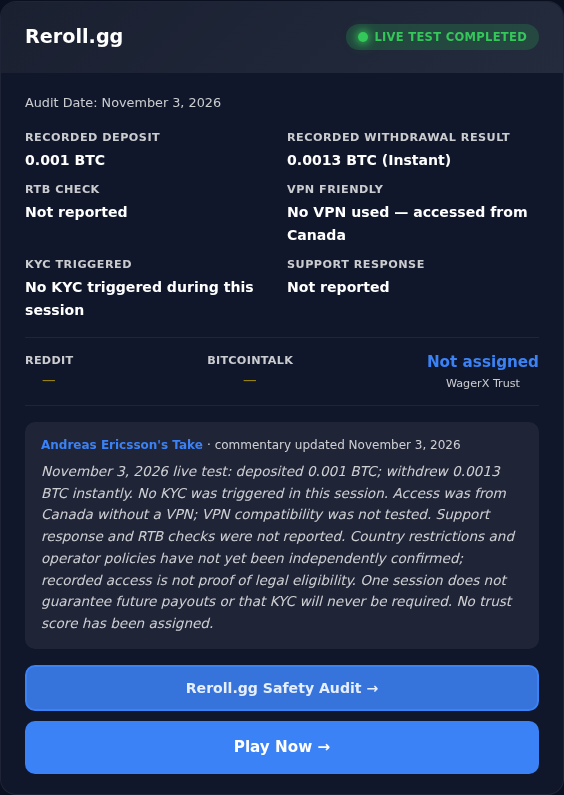
A successful withdrawal is evidence of what happened in one recorded session—not a guarantee of future payouts. No KYC in one session does not mean verification will never be requested. An unreported check must remain unreported.
Transparency, compliance, and player protection
In an ecosystem intersecting cryptocurrency and online gambling, operational transparency is paramount. Players must clearly understand payout conditions, KYC triggers, structural terms, and operational risks before depositing.
That requires going far beyond promotional marketing copy:
- Evidence-led auditing: examining recorded withdrawal speeds, support responsiveness, terms and operational clauses, with dates and a clear account of what was not tested.
- Jurisdictional controls: applying section-level geographic restrictions and recorded operator-specific restrictions. WagerX’s controls do not establish a reader’s legal eligibility or guarantee compliance with every jurisdiction’s laws.
- Player protection: making responsible-gambling information and risk disclosures part of the publication, rather than an afterthought.
Casino test results and regulatory evidence are separate. Our regulatory intelligence is a source-linked research resource, not a substitute for legal advice or a blanket endorsement of an operator.
Market realities: growth driven by digital
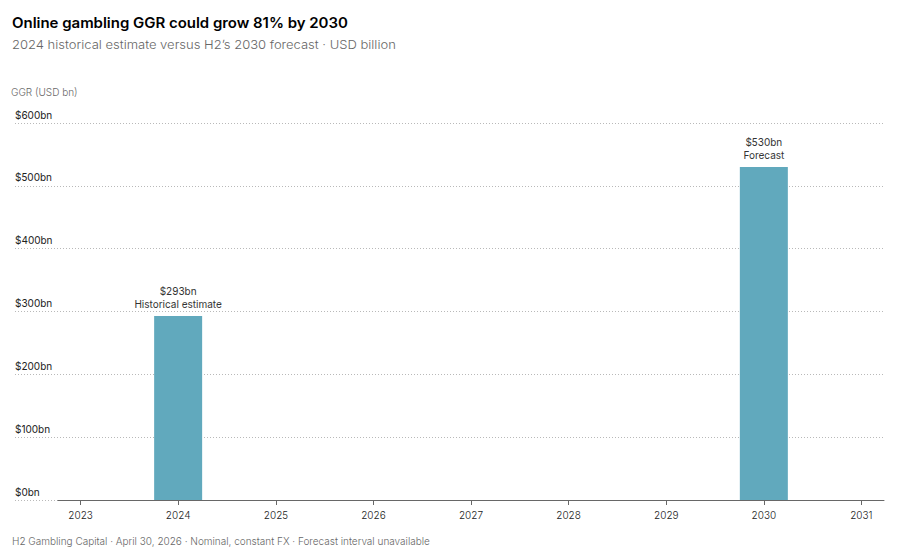
The broader gambling sector remains massive. In its April 30, 2026 market update, H2 Gambling Capital forecasts global gross gaming revenue (GGR) of $1.031 trillion in 2030.
H2 estimates that online gambling generated $293 billion in GGR in 2024, representing 41% of the global total. Its 2030 online forecast is $530 billion—51% of total global GGR. That is approximately 81% above the 2024 figure. H2 forecasts the online channel reaching a majority for the first time in 2029.
GGR is gambling revenue after winnings paid to players, before other costs. It is not total stakes, operator profit, or affiliate revenue.
| Year | GGR | Global share | Basis |
|---|---|---|---|
| 2024 | $293bn | 41% | Historical estimate |
| 2030 | $530bn | 51% | Forecast |
Source and forecast limitations: H2 Gambling Capital, April 30, 2026. The 2030 figures are forecasts, not observed results. H2 reports nominal growth using constant exchange rates; growth therefore includes inflation, and different future exchange-rate assumptions can produce lower USD/EUR forecasts. These figures cover online gambling broadly—not just online casinos or affiliate revenue. H2’s public article does not provide a forecast confidence interval. The approximately 81% comparison is calculated as (530 − 293) ÷ 293.
The key insight is not that every affiliate site will thrive automatically as the industry grows.
The takeaway is that the underlying market is forecast to expand, but the delivery mechanisms are changing. Publishers entering the space looking for quick SEO wins will face steep headwinds. Building a durable brand requires deep domain expertise, technical rigor, and player-first transparency.
Conclusion: the path forward
So, is online gambling affiliation dead?
No. But the legacy model—treating players as mere click counts, rankings as ad units, and reviews as conversion funnels—deserves to be disrupted.
The future of affiliation isn’t about eliminating commercial relationships. It is about ensuring those commercial ties do not corrupt the integrity of the information being provided.
At WagerX, our objective is simple: help players navigate a complex industry with verifiable intelligence, transparent evaluations, and clarity on risk.
The old model may be dying. That doesn’t mean the business has no future—it means we have the opportunity to build a better one.
Editorial and commercial disclosure: This is Andreas Ericsson’s opinion, adapted from his supplied draft with AI assistance for editing, sourcing and presentation. WagerX has commercial affiliate relationships; readers should account for that potential conflict when assessing our position. This article does not rank casinos, promise returns, or provide legal or investment advice.
18+. Gambling carries financial risk. Only participate where legally permitted, and never with money you cannot afford to lose. Responsible gambling information.