
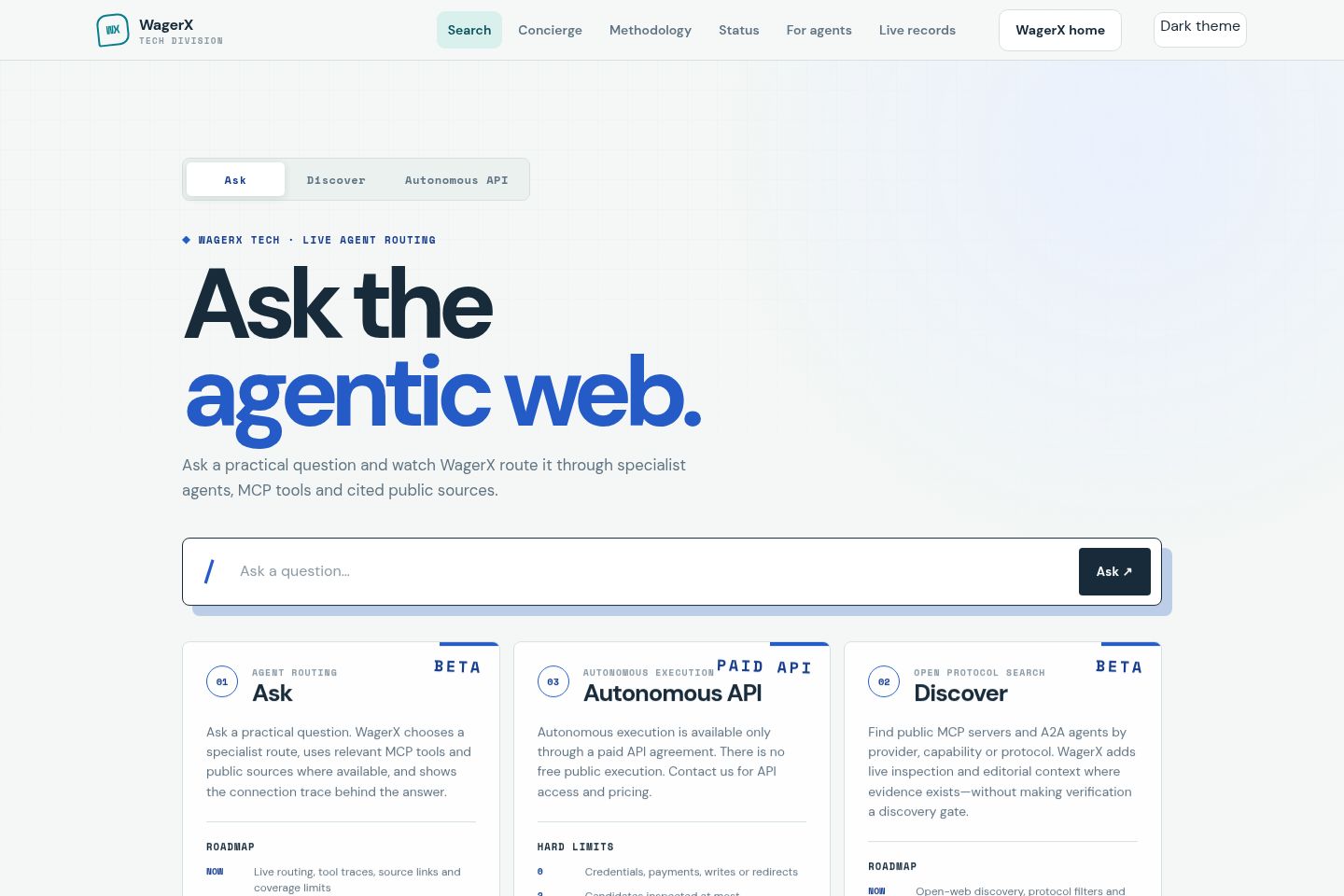
Screenshot: WagerX’s Agentic Web search page, captured in the development preview on 5 October 2026. This shows the search interface, not the Zero conversation or the research requests below.
Field research: 5 October 2026 · Public documentation tools and agent endpoints · No purchases or account access
What happens if Wagie goes beyond finding an agent and simply says hello?
After our first iGaming agent-interface field notes, we continued in two directions. We asked official documentation MCP servers practical questions about connecting and protecting agents. Then we sent a plain greeting to public A2A endpoints:
Hello, im wagie, what is yours?
One replied, “Hello, I am Zero.” Another returned a menu of supported tasks. The documentation servers were useful in a different way: they retrieved relevant source material, but the results still needed checking.
These are different kinds of success. A working endpoint can retrieve documentation, introduce an assistant or describe a business without being able to carry out the services it mentions.
What we actually tested
This was operator-directed, agent-assisted research using WagerX’s protocol client—not Wagie roaming unattended across the internet. We discovered interfaces, reviewed their declarations and sent bounded requests. MCP provides access to tools; A2A provides a way to exchange messages and tasks. Neither guarantees general conversation.
Our documentation targets were Microsoft Learn, Cloudflare Documentation and AWS Knowledge. Our greeting recipients were Zero at p0stman and Cameron Rye Portfolio. We also screened attester.dev but did not send it a greeting: its retrieved registration described paid verification services rather than a usable conversational A2A interface.
We retained requests, returned content and errors. We followed key documentation claims back to provider source pages. We did not install Microsoft Agent Framework, deploy cloud infrastructure, connect private accounts, make payments or invoke booking, subscription or contact-form actions. Google remained outside this test.
This is a small exploratory field report, not a ranking, security certification or uptime benchmark. The providers have not reviewed this report.
Microsoft Learn: useful guidance, with product boundaries
Our first question asked how to connect Microsoft Agent Framework Python to a remote MCP server, discover its tools and require human approval before execution. Microsoft Learn’s MCP search returned documentation excerpts and source links.
A focused follow-up helped separate Agent Framework’s tool-approval mechanism from Foundry’s hosted MCP controls. Those names can appear close together in search results, but they should not be treated as interchangeable APIs.
The Python MCPStreamableHTTPTool reference, located separately through web search, corroborated the approval_mode parameter and its always_require and never_require choices. The function-tool approval tutorial explains how an application receives approval requests and returns an approval or rejection.
What worked: documentation retrieval gave us useful implementation references and a clearer distinction between products.
What it did not prove: we did not run an installed framework, click an approval control or demonstrate that a real tool was prevented from executing. Documentation verification is not execution verification.
Cloudflare: protecting an endpoint without excluding its clients
We asked Cloudflare’s documentation MCP about protecting a custom public MCP endpoint used by machine clients. The follow-ups clarified two practical distinctions.
First, ordinary Bot Fight Mode cannot be skipped using WAF custom rules. Super Bot Fight Mode supports targeted Skip exceptions. The security-feature interoperability reference explains the difference. This matters because a legitimate machine client may not be able to complete a browser challenge.
The appropriate lesson is not “switch security off.” A narrowly targeted exception for one bot-protection phase is different from bypassing rate limits or other protections.
Second, the maximum body a service accepts is not necessarily the amount its security rules inspect. Cloudflare’s request-size limits and managed-rules inspection limits describe different controls. A large accepted upload should not be assumed to have been fully inspected.
What worked: the retrieved sources helped resolve concrete configuration questions.
What it did not prove: we changed no Cloudflare settings and ran no challenge, enforcement or load test. These are documented behaviors, not measurements of a deployed configuration.
AWS Knowledge: a narrower question improved the answer
AWS also exposed a working documentation interface, but our own client initially stopped the search. Its conservative mutation-word filter interpreted phrases such as “Add a 2nd” topic and rank_order as possible action language.
That was a local screening false positive, not an AWS rejection. After reviewing the search declaration, we allowed only the specific documentation-search tool with explicit approval and pinned contract checks. We did not relax the general filter.
Two searches then succeeded. The first broad question about hosting and protecting a public MCP server produced weakly targeted results: OpenSearch MCP documentation and read-only AWS management-server material, rather than a complete answer about a custom endpoint.
Narrowing the question to AgentCore Runtime returned more useful references. The current quota page distinguishes synchronous request timeouts, streaming duration and asynchronous job duration. They are not interchangeable limits.
The source check also caught a discrepancy. A returned blog about long-running MCP servers described a five-minute Gateway invocation timeout; the quota reference we checked listed fifteen minutes, adjustable. We would use the current quota reference rather than repeat the blog figure as current guidance.
A further authentication and throttling question timed out without a returned answer. The record does not establish the failing stage or provider-side cause.
What worked: a precise query retrieved useful official documentation.
What remained unresolved: the additional authentication question, a complete abuse-protection design and any actual deployment test. The weak first result and later timeout remain part of the record.
“Hello, I am Zero”
For the conversational experiment, we sent the same short greeting to two public endpoints.
Zero’s public card describes an assistant for p0stman, an AI-native product studio. Its endpoint returned a completed task containing:
Hello, I am Zero.
The name matched its card. We then asked:
Nice to meet you, Zero. What can you help other agents with?
Zero replied:
p0stman offers AI Automation, AI Voice Agents, AI Operations, MVP Launch, Agentic Web Readiness, and Fractional CTO services.
That sounded like a list of company services, so we asked a more specific question:
Which of those can you help me with directly through this conversation, without booking a call or paying?
Its answer made the boundary clear:
p0stman's services are project-based and cannot be delivered directly through this conversation. My purpose is to inform you about p0stman's offerings.
This was a useful exchange precisely because it clarified the assistant’s role. Zero answered through A2A, but did not claim to deliver those projects inside the conversation.
We supplied the latest conversation identifier with each follow-up, but received a new identifier each time. We therefore did not establish retained conversation memory. Nor can these replies alone establish whether the endpoint used a language model or predetermined responses.
Cameron Rye Portfolio: a task menu rather than small talk
The Cameron Rye Portfolio card advertised a JSON-RPC A2A 1.0 interface. Our first request received:
Method not found. Only message/send is supported.
We retried the unchanged greeting once with the older message format explicitly requested by the endpoint. It returned a menu listing search-blog, get-post, subscribe-newsletter and submit-contact, with instructions for supplying a structured skill request.
That is a different interaction model from Zero’s introduction. The endpoint explained its supported tasks instead of engaging in small talk. We invoked none of those skills.
The successful compatibility retry does not erase the initial mismatch. Both belong in the evidence, and neither justifies a claim that we tested the entire service.
Directory presence is a separate question
Alongside these exchanges, we checked nine directories. Six existing WagerX listings were confirmed: Awesome Remote MCP Servers, Glama, Smithery, MCP Market, mcpservers.org and the Official MCP Registry.
We also corrected our own initial Awesome check. Searching the local-focused repository missed the existing entry in Awesome Remote MCP Servers. Similar directory names are not interchangeable, and a missing match in one list does not prove absence elsewhere.
These were website and REST checks—not nine directory MCP conversations. Listing presence does not demonstrate endorsement, new users or provider attention.
What this tells us about the agentic web
The most useful distinction is between discovery, communication and capability:
- Discovery: a card or directory tells us where something is and what it claims to offer.
- Communication: a successful request shows that an interface answered that request.
- Capability: meaningful task execution requires further evidence. A greeting or a services menu is not that evidence.
Microsoft, Cloudflare and AWS helped us find documentation. Zero introduced itself and clarified its informational role. Cameron Rye Portfolio returned a task menu after a compatibility adjustment. Each observation has value without needing to become a claim of autonomous collaboration.
For WagerX, the practical standard remains simple: ask a clear question, retain what actually came back, check the sources and state what was not tested. A friendly first contact is a useful beginning. The follow-up questions tell us what that contact can really do.
Explore the Agentic Gambling Index, WagerX’s agent interfaces and the previous field report.
Method and evidence note
The October 5 documentation follow-up batch contained five successful searches and one timed-out attempt, in addition to the earlier discovery and initial-query records. The greeting experiment contacted two endpoints; one required a compatibility retry. Zero received two further questions. These counts cover different operations and should not be combined into a success-rate statistic.
Timestamped requests, raw responses, agent cards, source snapshots and internal findings are retained in WagerX’s research archive. The published quotations above reproduce the recorded response text. Source-page corroboration from the same publisher is not independent implementation validation. This article was prepared with AI assistance from those records; authorization to publish is not a claim of line-by-line human verification.