
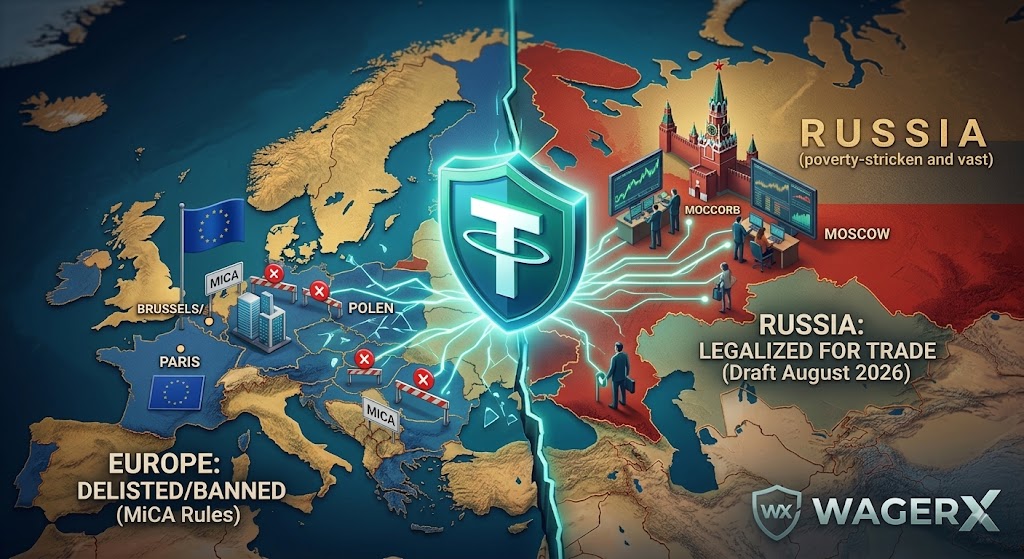
The Great Stablecoin Split: Russia Wants USDT Inside the System — Europe Is Pushing It Out
WagerX Regulatory Intelligence
If you wanted to map the new geopolitical fault lines of global finance, you wouldn't look at fiat currencies. You'd look at Tether (USDT).
On August 11, 2026, the Bank of Russia published a draft directive proposing that Bitcoin, Ethereum and USDT be made available to non-qualified investors through regulated Russian intermediaries — with an annual purchase limit of 300,000 rubles per intermediary and a mandatory knowledge test. Qualified investors would get broader access. It's part of Russia's push to pull crypto trading into regulated financial infrastructure.
Meanwhile, the European Union has been moving in almost the opposite direction. Under MiCA, USDT has steadily disappeared from regulated European trading venues, because Tether hasn't obtained the authorisation required for compliant stablecoin offerings. Major platforms have restricted or removed USDT trading for EEA users, while MiCA-compliant alternatives like USDC have gained ground.
The result is a remarkable regulatory split — the kind we log daily in our regulatory intelligence feed:
Russia is trying to bring USDT inside the regulated perimeter. Europe is pushing it outside.
The token is the same. The regulatory philosophy is not.
Why USDT matters in the first place
Born as Realcoin in 2014 before becoming Tether, USDT was built to give people a digital dollar without touching the traditional banking system. A decade later it's much more than a trading pair. For millions of users it is the dollar — used for moving value between exchanges, protecting savings against local currency collapse, cross-border transfers, settlement, and moving money where banking is expensive, restricted or simply unavailable.
That global role is exactly why its regulatory treatment matters. Europe is asking whether a dollar stablecoin issued outside the EU fits its regulated architecture. Russia is asking whether the enormous existing demand for crypto can be brought into a controlled domestic framework. Two very different questions.
The EU: regulate the gateway
Here's the part most headlines get wrong: MiCA does not make USDT illegal for Europeans to own.
MiCA regulates the companies through which crypto-assets are offered and traded. A European user can still hold USDT in a self-custody wallet — the blockchain hasn't disappeared, and MiCA doesn't switch USDT off. What changed is the regulated gateway: if a MiCA-authorised exchange can't legally offer trading in a stablecoin, it has to restrict the service. OKX, for example, states that USDT can't be offered to EEA retail users on its MiCA-licensed platform without the necessary issuer authorisation.
And the effect is measurable. Research published in July 2026 found USDT trading contracted on regulated-facing exchanges while USDC gained relative share.
So for an EU user, the practical consequence is not "your USDT is illegal." It's "your choice of regulated gateways is shrinking." That means converting to USDC or euros, self-custody for holding, and extra conversion steps when moving between USDT liquidity and EU-regulated venues. For a casual holder, an inconvenience. For an active trader or a business settling in USDT, real friction.
Russia: bring the asset inside
Russia's approach is strikingly different. Instead of eliminating the asset from regulated markets, the Bank of Russia proposes making BTC, ETH and USDT available to ordinary investors through regulated intermediaries.
But it's no free-for-all. Non-qualified investors face the 300,000-ruble annual cap per intermediary — roughly $3,600–$3,700, not a large ceiling for an experienced crypto investor — plus the knowledge test. Qualified investors get access to exchange and OTC crypto markets without the same purchase restrictions.
Russia is effectively saying: you can have access to crypto — but we control the doorway. That's very different from banning it outright.
USDT's inclusion is the interesting part. Russia is pursuing de-dollarisation, yet one of the three assets chosen for ordinary investors is a token whose entire purpose is to represent the US dollar. That sounds contradictory until you remember why USDT was picked: liquidity. The dollar may be politically inconvenient. The digital dollar is still extremely useful.
What it means at the player level
This is where it lands for our readers — anyone whose money moves between exchanges, wallets and crypto casinos, where stablecoins are popular precisely because they combine dollar-denominated accounting with fast blockchain settlement.
The Russian user gets a path toward legitimate, predictable, regulated access to BTC, ETH and USDT — but with a low ceiling and considerably less anonymity than the informal crypto economy. Controlled access, not freedom.
The EU user keeps a mature regulated market and full self-custody rights — but fewer regulated venues willing to touch USDT. If your entire workflow is built around USDT, every removed gateway adds a conversion step, a fee and a point of friction:
Before: Bank → Exchange → USDT → Wallet → Casino → Wallet → Exchange
After: Bank → Exchange → EUR/USDC → conversion → USDT → Wallet
For USDC users, the shift barely registers. For anyone deeply embedded in the USDT ecosystem, it changes the plumbing underneath their entire crypto workflow.
| 🇪🇺 EU user | 🇷🇺 Russian user | |
|---|---|---|
| USDT on blockchain | Still exists | Still exists |
| Regulated exchange access | Increasingly restricted | Proposed regulated access |
| USDT specifically | Increasingly unavailable on MiCA venues | Specifically included |
| Retail purchase cap | No MiCA-wide USDT purchase cap | ₽300,000/year per intermediary under proposal |
| Alternative stablecoin | USDC increasingly important | USDT remains one of the selected assets |
| Self-custody | Still possible | Still possible, subject to applicable Russian rules |
| Main friction | Finding regulated USDT liquidity | Limits and regulatory controls |
| Main trade-off | More compliance, fewer USDT gateways | More access, more state oversight |
Neither user has the "better" system. They have different constraints.
Two regulators, two philosophies
Brussels: regulate the issuer, regulate the intermediary, control the gateway, require compliance before access.
Moscow: accept the existing market, select the most liquid assets, bring them into regulated infrastructure, control who can access them and how much they can buy.
Neither approach makes USDT disappear. MiCA can regulate the European gateway to USDT — it cannot regulate the existence of USDT itself. Russia is attempting the opposite: rather than pushing USDT outside the regulated perimeter, it's pulling the asset inside one.
The token hasn't changed. The doorway has. And for crypto users, the doorway may ultimately matter as much as the asset on the other side.
Got questions about how MiCA or the Russian draft affects your setup? Ask Wagie — our AI agent tracks the same regulatory feed we do.
MiCA (Markets in Crypto-Assets): the EU's crypto framework. Its stablecoin rules require issuer authorisation before a token can be offered on regulated EEA venues. Tether has not obtained that authorisation for USDT, so MiCA-licensed exchanges restrict or delist it. MiCA does not ban holding USDT in self-custody, and there is no MiCA-wide purchase cap.
Bank of Russia draft (Aug 11, 2026): proposes regulated access to BTC, ETH and USDT for non-qualified investors via Russian intermediaries — capped at ₽300,000/year (~$3,600–$3,700) per intermediary, with a mandatory knowledge test. Qualified investors get broader exchange and OTC access. Still a draft, not law.
USDT (Tether): launched 2014 as Realcoin; the largest dollar-pegged stablecoin and a core piece of global crypto plumbing — exchange settlement, cross-border transfers, savings protection, and fast dollar-denominated payments, including in crypto gambling. July 2026 research already measured USDT losing share to USDC on regulated-facing EU exchanges.