
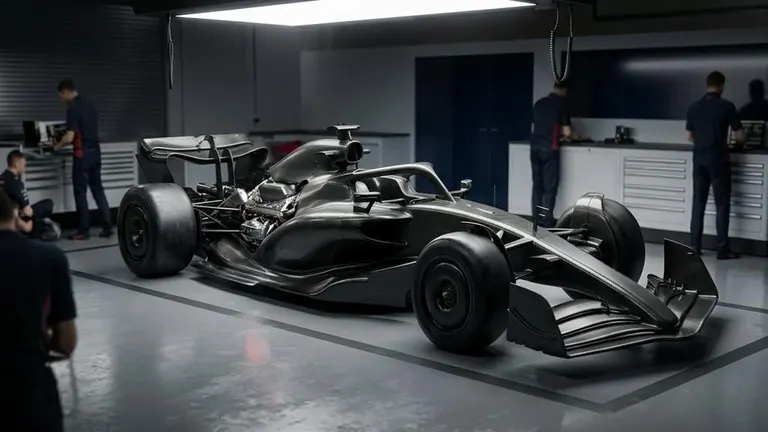
WagerX Racing Intelligence / Inside the Machine / 2026 edition
A car with no price list. A hybrid system that makes braking part of acceleration. A tyre decision that can undo a perfect drive. This is the machinery behind the spectacle.
You do not need an engineering degree to enjoy Formula 1. You need to know where to look. The radio message, the coloured stripe on a tyre and the movement of a driver's thumb can explain a race long before the finishing order does.
- Reported car-cost estimate
- $15m–$22m Unofficial range, not an invoice
- Combustion engine
- 1.6L V6 Turbocharged and hybrid-assisted
- MGU-K electric power
- Up to 350 kW About 469 hp, not constant deployment
- Wet-weather choices
- Green / Blue Intermediate / Full wet
How much does an F1 car actually cost?
No official public price exists. RTR Sports Marketing reports unofficial 2026 build estimates of $15 million–$22 million. Treat that as an order of magnitude, not a quotation from a team. Read the estimate and its limitations.
The surprising part is not just the price. There is no finished model rolling off an assembly line. A team designs, manufactures, tests and replaces components throughout the season. The car at the final race is not simply the car from the opening weekend with more mileage.
| Component | Reported estimate | What you are paying for |
|---|---|---|
| Power unit | $8m–$11m | Highly specialised hybrid machinery; supply and support arrangements complicate comparisons. |
| Carbon-fibre monocoque | $650,000–$1.2m | The driver's survival cell, not the complete car. |
| Gearbox | $450,000–$600,000 | A lightweight, tightly packaged transmission. |
| Front wing | $150,000–$300,000 | Complex aerodynamic surfaces manufactured in small quantities. |
| Steering wheel | $50,000–$100,000 | Bespoke controls, electronics and the driver's interface. |
All ranges above are attributed to the same secondary source, RTR Sports Marketing's October 2026 update. WagerX has not audited team invoices. These are not a complete bill of materials: do not add them up and call the result a verified car price.
The $215 million figure is a different question
The FIA's 2026 Financial Regulations set a $215 million base team cost cap for 24 or fewer competitions, subject to applicable indexation. More than 24 competitions trigger a specified additional allowance. This is a limit on defined Relevant Costs, not a limit on every dollar the organisation spends and certainly not the price of a car. FIA Section D, D4.1.2.
Exclusions include marketing, driver remuneration and remuneration for the three highest-paid qualifying individuals, alongside other defined categories. Power-unit manufacturers have separate financial regulations. A headline cap cannot be divided by two to discover what each race car costs.
That is why a crash can hurt beyond the result. Replacing damaged performance parts can consume resources that might otherwise support development. The exact trade-off depends on the damage, spare inventory and the team's accounting—not a universal “one crash equals one cancelled upgrade” formula.
What is inside a 2026 F1 power unit?
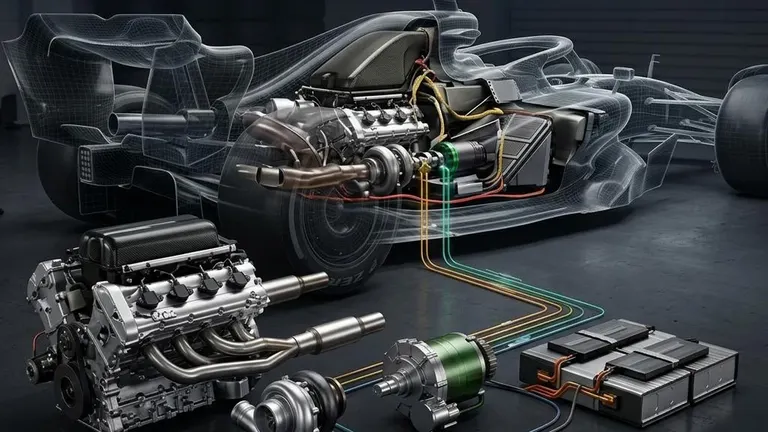
The 2026 system combines a 1.6-litre turbocharged V6 with an MGU-K motor-generator, energy store and control electronics. The MGU-H used in the previous generation is gone. The MGU-K's quoted maximum power increases from 120 kW to 350 kW. Formula 1's 2026 power-unit explainer.
| Part | What it does |
|---|---|
| Internal combustion engine / ICE | The 1.6-litre V6 converts fuel energy into mechanical power. |
| Turbocharger / TC | Uses exhaust energy to compress intake air so the engine can produce more power. |
| MGU-K | Works as a generator to recover energy and as a motor to deliver electrical power into the drivetrain. |
| Energy store / ES | The battery stores electrical energy for deployment. |
| Control electronics / CE | Coordinates the electrical system within the permitted operating limits. |
How much horsepower does that mean?
350 kW is approximately 469 mechanical horsepower (350 × 1.341). That is the electric contribution at its quoted maximum, not the entire power unit. It also does not mean every driver has 469 electric horsepower available continuously from lights out to the chequered flag.
F1 describes the 2026 direction as a much closer split between combustion and electric power. Actual combined output and delivery vary with the power unit, speed, energy available and deployment rules. A single “1,000+ hp” headline does not explain when that performance can be used.
Braking is part of the next acceleration
During recovery, the motor-generator converts mechanical energy into electrical energy. Later, deployment turns stored energy back into assistance at the rear wheels. Recovery is not limited to braking: the maps and rules also allow energy harvesting in other operating conditions. The interesting question is where to spend that energy.
Era check: the six-element diagram that includes an MGU-H describes the 2014–2025 architecture, not the 2026 system. Likewise, an older engine-efficiency claim should not be presented as a measured figure for every current power unit.
Slicks, intermediates and wets: which tyres do what?
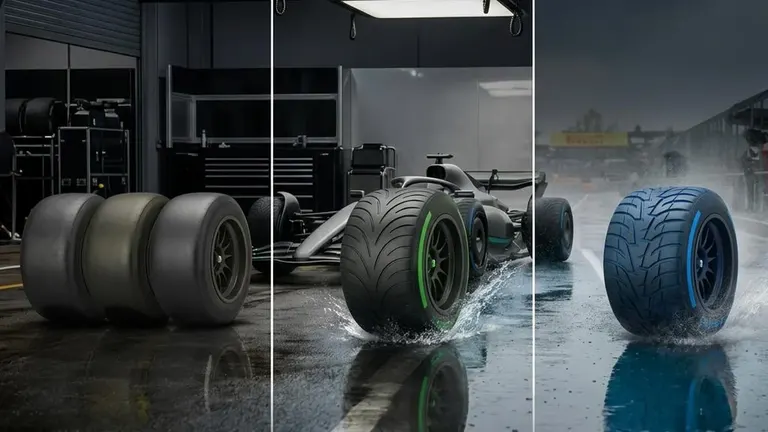
Slicks are for dry running, green intermediates for damp or drying conditions, and blue full wets for wetter conditions and standing water. The right tyre depends on water, temperature and the state of the racing line—not just whether somebody in the grandstand has opened an umbrella. Pirelli's 2026 tyre range.
| Tyre | Marking | Typical use | The compromise |
|---|---|---|---|
| Hard slick | White | Dry track | Hardest of the weekend's nominated slicks; warm-up and durability depend on conditions. |
| Medium slick | Yellow | Dry track | The middle nominated compound, not automatically the best race tyre. |
| Soft slick | Red | Dry track | Softest nominated slick; potential grip comes with temperature and wear trade-offs. |
| Intermediate | Green | Damp, light rain or a drying surface | Grooves clear water; too little water can make temperature management difficult. |
| Full wet | Blue | Wetter surface and standing water | Deeper tread helps clear water, but spray, visibility and aquaplaning can still stop racing. |
Why not put tread on every tyre?
On a dry track, a slick avoids cutting the contact surface into tread blocks. Add standing water and that changes: water must escape from beneath the tyre. Grooves help do that. A full wet is not “a slower slick”; it is solving a different problem.
Which tyres does Ferrari use?
Ferrari uses Pirelli, just like the rest of the grid. The strategic choice is which allocated compound and set to use, when to stop and how to manage it. Teams are not choosing between rival tyre manufacturers.
For 2026, Pirelli's dry range runs from C1 to C5. White, yellow and red identify the hard, medium and soft choices nominated for that weekend. “Soft” is therefore relative to the selection: it is not one identical compound at every grand prix.
The familiar 30- and 85-litres-per-second water-clearance numbers are not used here as universal 2026 specifications. Such measurements need a defined tyre generation and test speed; a bare number can conceal more than it explains.
What does an F1 steering wheel actually control?
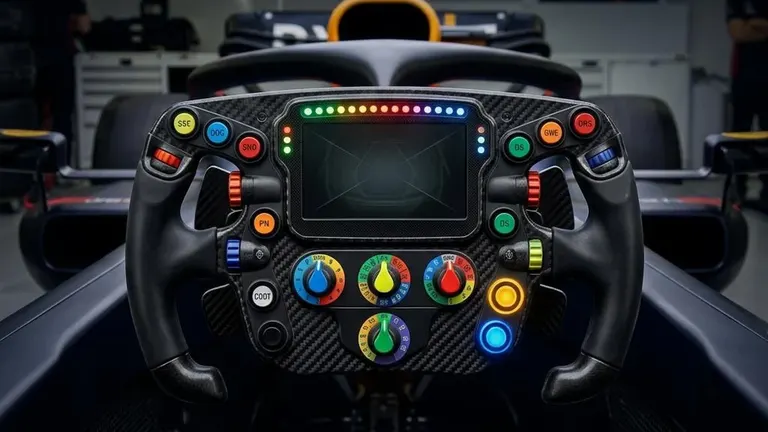
Far more than direction: gear changes, clutch operation, brake-balance adjustments, differential settings, energy functions, radio and the pit-speed limiter. Layouts, labels and button colours vary by team and driver; there is no universal colour-coded F1 wheel.
| Control | Purpose |
|---|---|
| Display and shift lights | Show selected information such as gear, timing, energy and warnings; lights help cue gear changes. |
| Gearshift paddles | Select the next or previous gear without taking hands off the wheel. |
| Clutch paddle or paddles | Let the driver manage clutch engagement for moving away, including the race start. |
| Brake balance | Changes the front-to-rear braking balance as conditions and handling evolve. |
| Differential settings | Alter how the driven rear wheels are allowed to rotate relative to each other. |
| Energy and boost controls | Select permitted settings and deployment functions; they do not create unlimited battery energy. |
| Pit limiter | Helps hold the applicable pit-lane speed limit, which depends on the event. |
| Radio and confirmation | Connect the driver with the team and acknowledge instructions. |
McLaren's explanation of brake balance shows why these controls matter: the car's behaviour changes with fuel, tyres and grip. The driver adjusts the balance rather than accepting one setting for the whole race. McLaren F1 Playbook.
DRS, Active Aero and Overtake Mode are not interchangeable
Older wheels often have a DRS label. For a 2026 explanation, separate the new systems: Active Aero changes front and rear wing configuration in designated zones. Overtake Mode gives an eligible following car a different electrical-energy profile under the rules. The Boost Button is another deployment tool, dependent on available energy. Formula 1's terminology guide.
A photograph of a previous-generation wheel can explain general controls, but it cannot establish the exact 2026 layout. Nor does a yellow button always mean pit limiter or a blue one always mean radio.
F1 car questions, answered
How much does an F1 car cost in 2026?
There is no official public build price. RTR Sports Marketing reports unofficial estimates of $15 million–$22 million for a 2026 car. This is an indicative range, not a team invoice, an audited WagerX valuation or an annual team budget.
What is the F1 cost cap in 2026?
FIA Financial Regulations Section D, Issue 08, D4.1.2 sets a base cap of $215 million for 24 or fewer competitions, subject to applicable indexation. Defined exclusions and adjustments apply; it is not the price of one car.
Does a 2026 F1 engine still have an MGU-H?
No. The 2026 power unit retains a 1.6-litre turbocharged V6, but removes the MGU-H. The MGU-K electric motor-generator, energy store and control electronics remain part of the hybrid system.
How powerful is the 2026 F1 electric motor?
Formula 1 describes the 2026 MGU-K as delivering up to 350 kW, approximately 469 mechanical horsepower. Deployment depends on the rules, energy available and operating conditions; that is not constant power throughout a lap.
Which F1 tyres are best in the rain?
Green-marked intermediates suit damp or drying conditions; blue-marked full wets are designed for wetter conditions and standing water. Neither makes every wet track safe, and the right choice depends on conditions.
Which tyres does Ferrari use?
Ferrari uses Pirelli tyres, the same supplier as the rest of the F1 grid. Teams choose from the allocated compounds and sets; they do not choose a different tyre manufacturer.
What replaced DRS in 2026?
The old DRS overtaking system was replaced by a combination of new tools. Active Aero changes front and rear wing configuration in designated zones; Overtake Mode is a separate electrical-energy advantage for eligible following cars. They are not the same function.
Sources and editorial method
Source-checked November 11, 2026. Technical explanations use Formula 1, Pirelli and team documentation; the cost-cap figure uses the FIA regulations. Car and component prices are attributed secondary-source estimates, not WagerX measurements. The kW-to-horsepower conversion is arithmetic, not an engine test.
- RTR Sports Marketing — reported car and component-cost estimates, updated October 2026
- FIA — 2026 Financial Regulations, Section D, Issue 08, October 1, 2026; D4.1.2 and D5.1.1
- Formula 1 — 2026 power units explained, January 14, 2026
- Formula 1 — Boost, Overtake Mode and Active Aero explained, December 17, 2025
- Pirelli — 2026 compounds, tyre colours and dimensions, December 9, 2025
- McLaren — F1 Playbook: brake balance, clutch bite point and race terminology
Images are AI-assisted conceptual illustrations adapted from supplied artwork. They are not photographs, official diagrams, exact engineering layouts or evidence of team affiliation. This is independent editorial coverage, not endorsed by Formula One Group, the FIA, Pirelli or any team.