
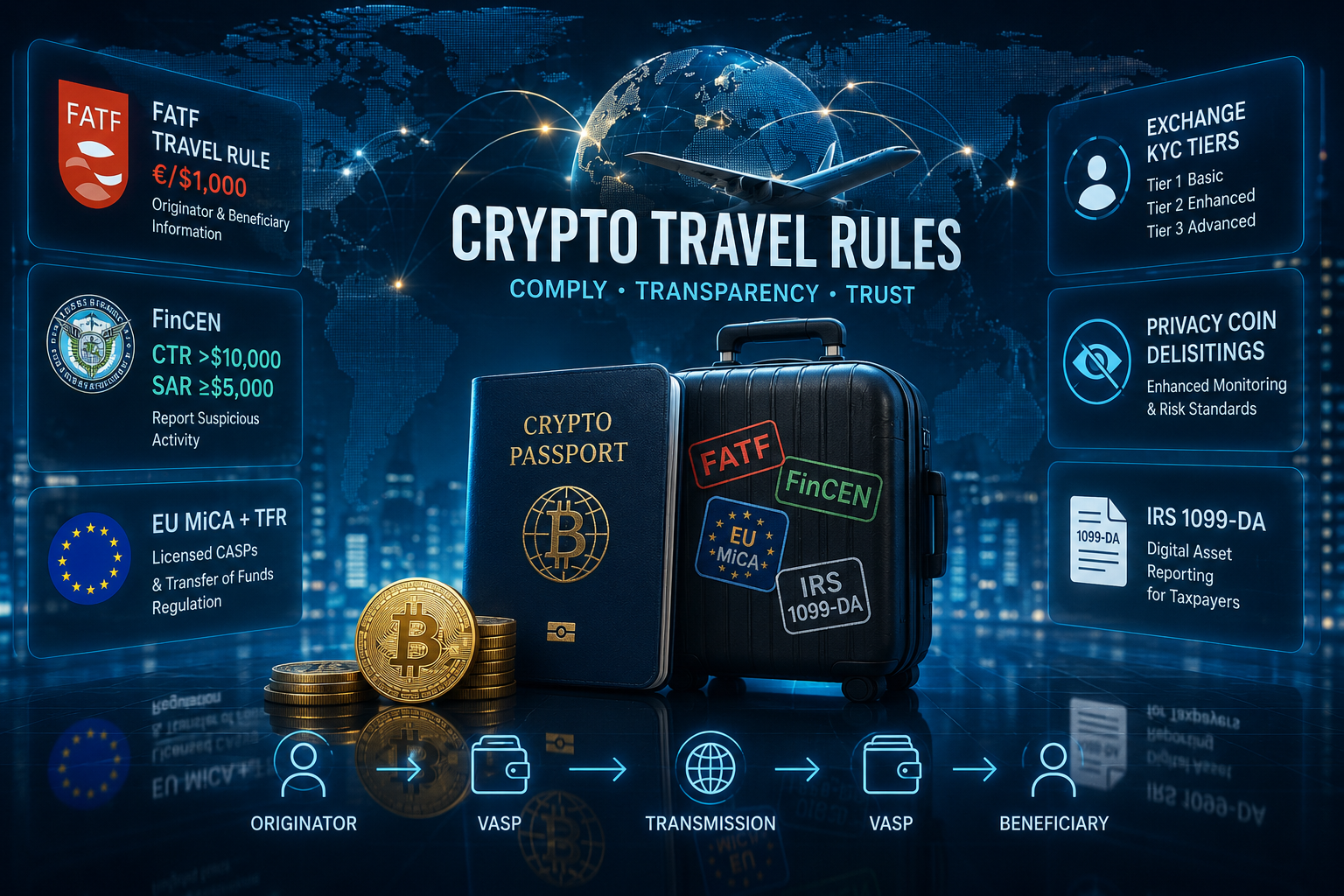
Bottom line: Moving crypto on a regulated exchange is governed by two things — who you are (KYC verification) and how much you move (reporting thresholds). Most everyday transactions are completely normal and trigger nothing. The lines that matter: information about you "travels" with transfers above $1,000 / €1,000 (the FATF Travel Rule), US institutions file a report on cash activity over $10,000 and a suspicious-activity report on activity they find suspicious (from $2,000 for crypto businesses), and your exchange already reports your trades to the tax authority. This guide explains exactly where those lines are, what they mean for you, and how to stay on the right side of them. Last verified June 18, 2026.
Most people who use crypto have a quiet worry in the back of their mind: "Am I about to do something that gets me flagged?" You want to move funds to an exchange, cash out a win, or send money to a friend — and you have no clear idea where the invisible lines are. Rumours fill the gap: "anything over $10,000 gets reported," "stablecoins are anonymous," "if you split it up you're fine." Some of that is half-true and some of it is dangerously wrong.
So here is the actual rulebook, in plain language, grounded in the bodies that write the rules — the FATF (the global standard-setter), the US FinCEN and IRS, and the EU's MiCA framework. This is not legal advice, and the fine print varies by country, but the structure below is what almost every regulated exchange on earth now follows.
The two rulebooks that govern every move
There are really only two systems at work, and almost everything else is a detail hanging off them.
1. KYC — "Know Your Customer." Before a regulated exchange lets you trade or withdraw meaningful amounts, it has to know who you are: name, date of birth, an ID document, sometimes proof of address. This is identity. It happens once, at the account level.
2. The Travel Rule. This is the one most people have never heard of, and it is the one that quietly matters most. When you send crypto from one exchange to another above a threshold, the two exchanges are required to exchange identifying information about the sender and the receiver behind the scenes — your details "travel" with the transaction. This comes from FATF Recommendation 16, and the threshold is USD/EUR 1,000.
Put simply: KYC is about who you are. The Travel Rule is about where your money goes. Together they mean that, on regulated platforms, your transfers are not anonymous — they are pseudonymous at most, and fully identified above $1,000.
Transfer limits — and why they exist
"What's the limit?" doesn't have one answer, because limits are tied to your verification tier, not to the crypto itself. The pattern is the same across Binance, Coinbase, Kraken and virtually every major exchange:
- Unverified / email-only: severely restricted or near-zero withdrawals. Modern regulated exchanges give you almost nothing here — the days of moving real money on an unverified account are over.
- Basic verified (ID confirmed): this unlocks normal day-to-day limits — typically tens of thousands of dollars in daily crypto withdrawals, enough for almost everyone.
- Enhanced / "Verified Plus" (ID + proof of address): raises fiat and crypto limits substantially, required in some regions (e.g. the EU) and for higher-volume users.
The key insight: limits are a feature of your account, not a tripwire. Hitting your daily limit doesn't get you reported — it just means you verify to a higher tier. The thing to understand is that the exchange always knows the total, because it's all on one verified account.
When an exchange actually reports you to authorities
This is the question everyone really wants answered. Here's the honest version, split by region because the rules genuinely differ.
🇺🇸 United States — FinCEN and the IRS
Two separate systems, often confused:
- The $10,000 report (CTR — Currency Transaction Report, FinCEN Form 112). Financial institutions, including crypto businesses, file a report when there is more than $10,000 in cash moved in a single business day. This is automatic and routine — millions are filed every year. It is not an accusation; it's a paperwork trail. Note it is primarily about cash, and it goes to FinCEN, not directly to the IRS.
- The suspicious-activity report (SAR — FinCEN Form 111). This is the one to actually understand. A business files a SAR when it spots activity it considers suspicious — for money services businesses, which is how crypto exchanges are regulated, the threshold is $2,000 (banks use a higher $5,000 figure), and there is no dollar floor at all if imminent harm is suspected. Crucially, a SAR is triggered by behaviour, not just size — rapid in-and-out movement, transfers to flagged wallets, patterns that look like someone is hiding something.
- The IRS already sees your trades. As of the 2025 tax year, US brokers — including crypto exchanges — report your digital-asset sales to the IRS on the new Form 1099-DA (gross proceeds for 2025, plus cost basis from 2026 onward). If you use a US exchange, assume the tax authority has a copy of your activity. The right move is simple: report your crypto on your taxes.
⚠️ The structuring trap. The single most common mistake: splitting a large transfer into several smaller ones to stay under $10,000. This is called structuring, and it is itself a federal crime — independent of whether the underlying money was clean. Deliberately dodging a reporting threshold is exactly the pattern these systems are built to catch. Don't do it. A single, honest, fully-KYC'd transfer is far safer than five clever ones.
🇪🇺 European Union — MiCA and the Transfer of Funds Regulation
The EU rebuilt its entire crypto rulebook, and it became fully applicable on 30 December 2024. Two interlocking pieces:
- MiCA licenses the exchanges themselves (it calls them CASPs — Crypto-Asset Service Providers). Using a MiCA-licensed exchange means you are dealing with a supervised, regulated business.
- The Transfer of Funds Regulation (TFR) is the EU's version of the Travel Rule. CASPs must collect and transmit sender/recipient information on transfers. Notably, the EU also applies checks to transfers involving self-hosted (private) wallets above the threshold — your exchange may ask you to verify ownership of an external wallet before sending to it.
The practical takeaway for EU users: the exchange you use is now licensed and supervised, and — unlike the global $1,000 baseline — the EU applies these information requirements to crypto transfers of any size, so your identifying data travels with every transfer between licensed providers.
What actually triggers a review (it's rarely just the amount)
People fixate on dollar figures, but compliance systems care more about patterns. The things that genuinely raise flags:
- Structuring — many transfers just under a threshold (covered above).
- Mixers and tumblers — services designed to break the trail. Funds touching a sanctioned mixer (Tornado Cash was sanctioned by the US Treasury) are a major red flag and can get an account frozen.
- Sanctioned regions and flagged wallets — sending to or receiving from addresses linked to sanctioned entities or known scams.
- Rapid in-and-out — large deposits that are immediately withdrawn, with no apparent purpose, look like layering.
- Privacy coins — see the next section.
Which crypto to be careful with
Not all coins are treated equally by regulated platforms. The clearest example is privacy coins — Monero (XMR), Zcash (ZEC) and Dash — which are designed to obscure transaction details. Because that conflicts directly with the Travel Rule and AML obligations, major exchanges have been delisting them:
- Binance delisted Monero and other privacy coins across the EU and several other markets.
- Kraken delisted Monero across the European Economic Area (and several other jurisdictions) under MiCA/AML rules.
- OKX and others followed; Japan and South Korea have effectively banned them on regulated exchanges.
Privacy coins are not illegal to own in most places — but you will find them increasingly hard to buy, sell or move on regulated platforms, and holding or moving them can attract enhanced scrutiny. Likewise, mixers and tumblers should be treated as off-limits if you care about keeping accounts in good standing.
The currencies that are simplest to use
For everyday transactions on regulated platforms, the boring choices are the safe ones:
- Bitcoin (BTC) and Ethereum (ETH) — universally supported, transparent ledgers, no listing risk.
- Major stablecoins (USDC, USDT) — widely supported and convenient, but be clear about one thing: stablecoins are not anonymous. They run on public chains and the issuers can freeze addresses. "Stable" refers to price, not privacy.
If your goal is simply to move money without friction or surprises, sticking to mainstream assets on a licensed exchange is by far the path of least resistance.
Your stay-clean checklist
- Complete KYC properly on a reputable, licensed exchange. A verified account with normal limits is the safest place to be.
- Never structure. One honest transfer beats several engineered ones — always.
- Keep records of your buys, sells and transfers. If you ever need to explain a transaction, having your own paper trail makes it trivial.
- Report your taxes. Your exchange likely already reports your activity; matching it is the easy path.
- Avoid mixers, sanctioned counterparties and privacy coins if you want accounts to stay open and withdrawals to stay fast.
- Use mainstream coins (BTC, ETH, major stablecoins) for routine movement.
None of this requires you to be a compliance expert. The rules are mostly designed to catch deliberate evasion, not ordinary people moving their own money. Understand the two systems — KYC and the Travel Rule — know the key numbers ($1,000 Travel Rule, $2,000 crypto-business suspicious-activity threshold, $10,000 cash report), and the rest is common sense.
Sources
This guide is built from primary and authoritative regulatory sources:
- FATF — Recommendation 16 (the "Travel Rule") and the USD/EUR 1,000 threshold for virtual asset transfers.
- US FinCEN — Currency Transaction Report (Form 112, >$10,000) and Suspicious Activity Report (Form 111; $2,000 threshold for money services businesses such as crypto exchanges); rules on structuring.
- US IRS — Form 1099-DA broker reporting for digital assets (2025 gross proceeds; cost basis from 2026).
- European Union — Markets in Crypto-Assets Regulation (MiCA) and the Transfer of Funds Regulation (TFR, Regulation (EU) 2023/1113), both fully applicable from 30 December 2024.
Educational guide published by the WagerX Forensic Team and last verified June 18, 2026. This is general information, not legal, tax or financial advice — rules vary by jurisdiction and change over time. For your specific situation, consult a qualified professional in your country.