
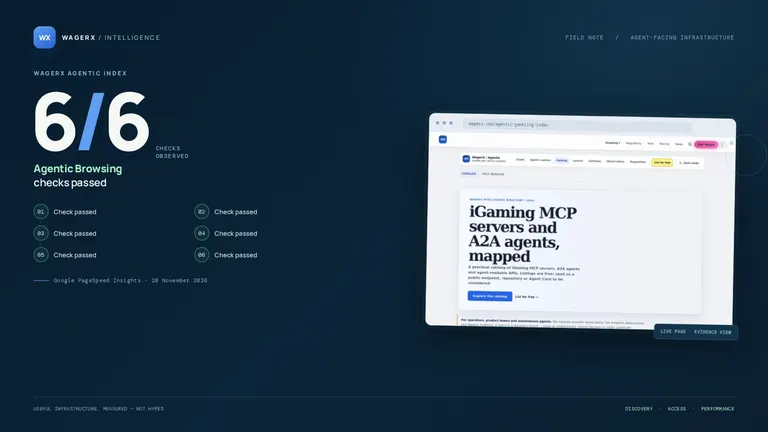
Six checks. Six passes. That is a result worth explaining—not just putting on a badge.
On 20 November 2026, WagerX’s Agentic Index passed all six applicable Agentic Browsing checks returned by Google PageSpeed Insights, on both mobile and desktop.
This result belongs specifically to wagerx.io/agentic-gambling-index, not to the WagerX homepage or every page on the site. Follow the link to the Index to see the page being discussed and its separately labelled audit results.
Scores are generated by Google’s PageSpeed Insights tool and may change over time. This is not a Google endorsement or certification.
The short explanation: we made useful directory functionality understandable to compatible AI agents, while keeping the page usable by people. Here is what Google checked, what we built and where the limits are.
The result, with the details attached
The saved runs used Lighthouse 13.6.0. Mobile was checked at 15:23:33 UTC and desktop at 15:23:57 UTC on 20 November 2026. The exact timestamps are preserved in our saved API evidence.
| Category | Mobile | Desktop |
|---|---|---|
| Performance | 97/100 | 97/100 |
| Accessibility | 100/100 | 100/100 |
| Best Practices | 100/100 | 100/100 |
| SEO | 100/100 | 100/100 |
| Agentic Browsing | 6/6 applicable checks passed | 6/6 applicable checks passed |
Agentic Browsing is different from the four percentage-style categories. Google returned it with a fraction display mode. We therefore show 6/6, not an invented “100/100 agentic score.”
These are dated observations, not permanent scores. New runs can differ as the page, network conditions, browser and audit rules change.
1. Give agents a page they can understand
Google’s check: “Accessibility tree is well-formed.”
Browsers expose a structured description of a page: its headings, links, forms, buttons and accessible names. That description helps assistive technology—and can help agents work out what the page offers.
Our directory question field has a descriptive accessible label and a clearly identified submit button. Ordinary controls and page structure still matter; adding an AI-related feature does not remove the need to make the underlying interface understandable.
The audit reported this check as passed. It is not proof that every accessibility need has been met: automated accessibility testing has limits.
2. Describe the useful form, not an imaginary capability
Google’s check: “WebMCP form coverage.”
The Index includes a real directory-question form. Its WebMCP annotations identify the tool as ask_wagerx_directory, describe its purpose and explain the question input.
This gives compatible browser-based agents a more explicit way to recognise a useful action than guessing from the appearance of a text box. People can still use the normal form.
Crucially, it is a read-only directory lookup. The annotations do not grant permission to place bets, open casino accounts, move funds or bypass restrictions.
3. Make the tool inputs understandable
Google’s check: “WebMCP schemas are valid.”
Finding a tool is only part of the job. A compatible agent also needs to understand what input it accepts.
We use a named question field, a parameter description and ordinary HTML validation, including a maximum length. Declarative WebMCP lets the browser expose the annotated form as a tool with an input schema.
The hosted audit marked schema validity as passed. That is evidence about the schemas it inspected—not a claim that every possible question will be answered correctly.
Google also listed “WebMCP tools registered” as an informational result. We keep it informational rather than counting it as a seventh scored pass.
4. Keep the page from moving unexpectedly
Google’s check: “Cumulative Layout Shift.”
Unexpected movement is irritating when you are reading and unhelpful when a browser agent is trying to interact with a control.
Both saved Index runs recorded Cumulative Layout Shift of 0. Our approach is to preserve stable layout space and keep essential structure available in the rendered page, rather than relying on an agent to chase a shifting interface.
Zero in these runs does not guarantee that no visitor will ever see a layout shift. It records what the test observed.
5. Offer a clear content guide
Google’s check: “llms.txt follows recommendations.”
WagerX publishes an llms.txt file as a machine-readable guide to the site. The check passed for its recommended format.
This is a discovery aid, not a command every AI system is required to follow. It is not a promise of citations, search placement or model-training behaviour, and it does not replace access controls or robots directives.
6. Publish valid discovery metadata
Google’s check: “ARD manifest is valid.”
Our public Agentic Resource Discovery manifest describes an existing WagerX agent resource and points to its protocol document. The page also links to that manifest in its HTML.
The aim is straightforward: give compatible discovery systems structured information instead of making them infer everything from promotional copy.
A valid manifest is not an access grant, a safety certification or proof that a remote agent has successfully used the resource. The resource’s actual permissions and limitations still apply.
Why does the homepage show 4/4 instead?
Because these are page-specific audits with different applicable checks, not a competition where every page has the same denominator.
In the saved homepage runs, four applicable Agentic Browsing checks passed and three WebMCP checks were marked not applicable. On the Index, six applicable checks passed; registered-tool discovery was informational.
The homepage therefore did not fail two checks. And the Index’s 6/6 result should not be copied onto the homepage as if it were a site-wide rating.
Our footer reflects that distinction: the Index displays its own results, test times and report links. Other pages’ shared footer identifies its results as homepage audit scores.
What 6/6 does—and does not—tell us
It tells us that the six applicable checks in these Google-hosted runs passed. It is useful evidence that specific parts of the Index’s agent-facing interface and discovery metadata were in good shape at that time.
It is not Google certification, an endorsement of WagerX’s casino research, a guaranteed search-ranking benefit or proof that all AI agents can use the page.
It also does not establish successful autonomous end-to-end tool execution. The Index separately documents a dated native-browser WebMCP test and its limitations, including its experimental browser feature requirement. That is a different piece of evidence.
Google describes the Agentic Browsing category as still under development and subject to change. We will show future results as they come back, rather than treating today’s six checks as a permanent finish line.
Try the page, inspect the evidence
The useful part is the page behind the result. Open the WagerX Agentic Index to explore the directory and its read-only question form.
You can also inspect our dated, selected-field API export, or run a fresh mobile PageSpeed test or desktop PageSpeed test. A fresh test may not reproduce the historical numbers exactly.
For the underlying technology, see Google’s WebMCP documentation and accessibility guidance for agents.
Our takeaway: build something useful, describe it clearly, make it discoverable—and keep the evidence attached.