Superior Intelligence
Trump’s AI naming poll raises a larger question: when does intelligence become “superior,” and superior to whom?
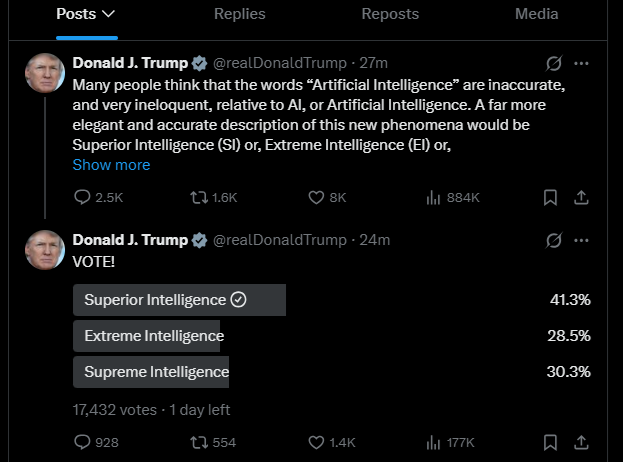
Donald Trump asked followers on X to choose between “Superior Intelligence,” “Extreme Intelligence” and “Supreme Intelligence” as alternatives to “Artificial Intelligence.” In the screenshot supplied to WagerX, Superior Intelligence was ahead. A poll cannot rename a scientific field, but a phrase amplified by someone with Trump’s reach can influence the language people use.
Superior Intelligence, explained
What does Superior Intelligence mean?
Superior Intelligence is a proposed alternative label for artificial intelligence, not an established technical category. The words imply capability that exceeds a comparison point, but they do not say which task, benchmark or group is being surpassed. Any claim of superiority therefore needs specific evidence.
Is Superior Intelligence a good name? WagerX opinion
WagerX’s opinion: it is memorable and usefully asks what machines may surpass, but it is too broad as a label for today’s AI. “Superior” can turn narrow advantages into a universal claim. The name is strongest when paired with a defined task, comparison and evidence.
Did Donald Trump invent the phrase Superior Intelligence?
No. “Superior intelligence” is an ordinary descriptive phrase that predates Donald Trump’s poll. His posts proposed using it as a new name for AI and gave that usage broad attention. WagerX has not identified or verified a single first coiner or invention date for the phrase.
Where was the poll about Superior Intelligence?
The naming proposal and poll were posted on X by @realDonaldTrump. The first post introduced alternative names and the second contained the poll. This article cites those two X posts as its sources; it does not attribute the poll to Truth Social.
Did Superior Intelligence win?
Not on the evidence available here. A captured snapshot showed Superior Intelligence leading with 41.3% of 17,432 votes while one day of voting remained. That is not a confirmed final result, and WagerX has not independently verified a later final result.
Has AI officially been renamed?
No. A social-media poll does not create an official technical rename, and artificial intelligence remains the established term used by researchers, standards bodies and providers. Superior Intelligence is a proposed label in a public naming conversation, not a replacement adopted by the field.
Is SI the same as ASI?
No. In this discussion, SI is shorthand for the proposed Superior Intelligence branding. ASI means artificial superintelligence, a hypothetical concept generally associated with systems that greatly exceed human intellectual performance across broad domains. Similar initials do not make the label and concept equivalent.
How does Superior Intelligence connect to the agentic web?
The agentic web lets software agents use tools, call services and complete multi-step work, so AI can do more than answer questions. That autonomy can increase impact, but it is not proof of superior intelligence. Capability still requires evidence, safeguards, clear permissions and accountable operators.
The poll snapshot, not a final result
The captured image showed Superior Intelligence leading with 41.3% of 17,432 votes. It also showed that one day of voting remained. Those figures are a snapshot of an open poll, not its final result, and WagerX has not independently verified a later live status. The evidence here is deliberately bounded to what was visible when the screenshot was captured.
Why “Superior Intelligence” has appeal
“Artificial intelligence” describes an origin: intelligence produced through human-made systems. “Superior intelligence” describes a position in a comparison. That makes it more dramatic, more aspirational and much more demanding. The two labels are not opposites. A system can be artificial and, at the same time, superior to a person at a particular task.
The established phrase artificial superintelligence, or ASI, usually refers to a hypothetical system that greatly exceeds human intellectual performance across broad domains. Superior Intelligence does not automatically mean ASI. It might instead describe the uneven transition already visible today: machines outperforming people in selected calculations, searches, classifications or games while remaining unreliable in other settings.
Superior at what—and compared with whom?
A leaderboard result is not a universal rank for intelligence. A model can process more documents than one analyst, translate a sentence quickly or identify a pattern across a large dataset. It can still misunderstand context, repeat a false premise or fail when the task changes. Speed, memory, reasoning, judgement, reliability and responsibility are separate dimensions.
“Artificial” tells us where a system came from. “Superior” makes a claim about how it compares.
That claim needs a benchmark and a reference group. Superior to an individual at one task? To a specialist team? To an institution operating under legal and ethical duties? A useful term must preserve those distinctions. Otherwise, branding can turn a narrow performance advantage into a blanket assertion that the evidence does not support.
From intelligence that answers to intelligence that acts
The terminology becomes more consequential as software agents gain access to tools. An agent may search a database, call an API, pass work to another service or complete a multi-step workflow. That changes what a model can accomplish in the world, and it is one reason WagerX tracks the emerging agentic web.
But autonomy is not the same as intelligence. Permission to act can magnify a system’s usefulness; it can also magnify an error. A capable agent therefore needs clear permissions, inspectable sources, bounded tools and accountable operators. Calling an agent “superior” does not provide any of those safeguards.
Infrastructure behind agentic work
These are current examples of agent-readable services documented in the Index. They are infrastructure examples, not Superior Intelligence systems. Status and evidence dates below come from the current catalog record and can change without changing this article’s editorial update date.
WagerX iGaming & Regulatory Intelligence MCP
casino audits; trust scores
MCP (streamable http) · A2A (JSONRPC 2.0)
Open evidence profile →SpinHire iGaming Jobs MCP
search_jobs (observed read-only call); get_job (declared tool)
MCP (Streamable HTTP, negotiated 2025-03-26)
Open evidence profile →Semrush MCP
SEO and keyword research (provider-documented); backlink and competitor research (provider-documented)
MCP (streamable HTTP)
Open evidence profile →Index inclusion is not an endorsement. “Verified” refers to the bounded checks described in a product profile, not a general security, compliance or intelligence certification.
WagerX’s view
Superior Intelligence is a compelling name for the direction some AI development may be heading. It captures the possibility that machines will exceed human performance across an expanding range of intellectual tasks. It also forces a useful question that “artificial” avoids: what exactly is being surpassed?
We would not use the phrase as a blanket description of today’s systems. Superiority should be demonstrated task by task, with evidence, limitations and consequences visible. If the term spreads, its value will depend on whether it encourages precise comparisons or merely supplies bigger branding.
- Whether the phrase travels beyond the original poll and political conversation.
- Whether researchers or major AI providers adopt it in a defined sense.
- Which capabilities improve, and whether gains hold outside controlled benchmarks.
- How agent permissions, evidence and accountability develop alongside capability.
Documented developments
WagerX added concise answers to common questions about the proposed name, the open poll snapshot, ASI and the agentic web.
A captured X poll showed Superior Intelligence leading while voting was still open. WagerX began tracking the term without treating the snapshot as a final result or an official rename.